


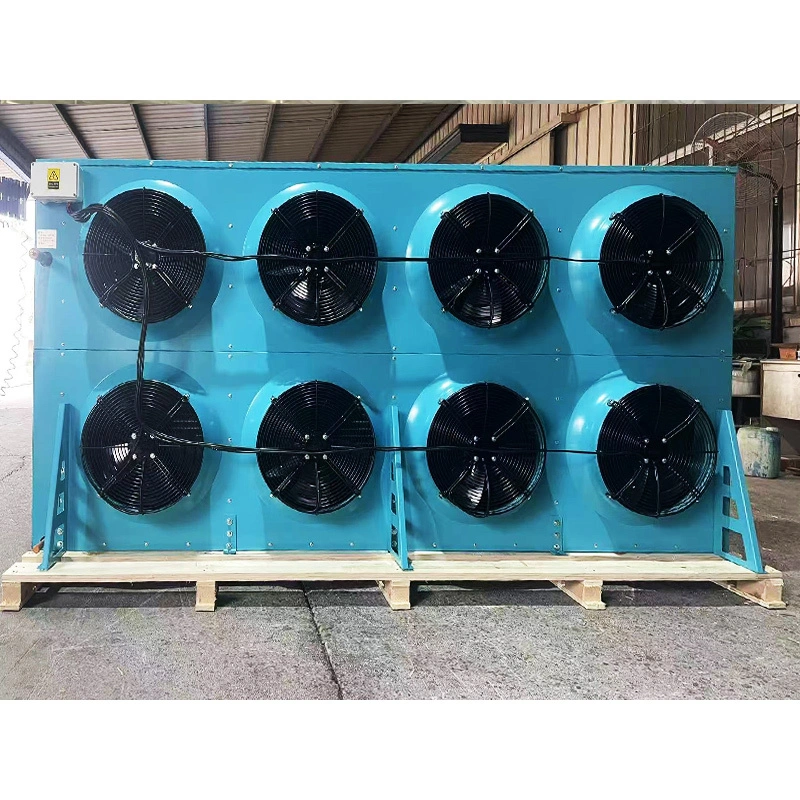
Air-Cooled Condenser
The condenser is a core heat exchange device in the refrigeration system. Its function is to cool the high-temperature and high-pressure gaseous refrigerant discharged from the compressor into high-pressure liquid refrigerant through heat exchange, providing conditions for subsequent throttling and evaporative refrigeration. Different types of condensers have significant differences in working principle, performance and application scenarios based on the differences in cooling media and heat exchange methods.
Working Principle
The air-cooled condenser uses air as the only cooling medium, with the core of indirect heat exchange between air and refrigerant. It requires no water or circulation system and has the simplest structure. Its specific working process is divided into two stages, and it is mainly composed of finned coils and forced draft fans:
• Refrigerant side circulation
The high-temperature and high-pressure gaseous refrigerant discharged from the compressor enters the finned coil of the air-cooled condenser through the inlet pipeline (the coil is made of copper, and aluminum fins are tightly wound outside the pipe to increase the heat exchange area; aluminum fins feature high thermal conductivity and light weight). The refrigerant flows inside the coil, releases heat through the pipe wall and fins, and its temperature gradually drops. Finally, it condenses into high-pressure liquid refrigerant and flows to the throttling device through the outlet pipeline.
• Air side circulation
The condenser is equipped with one to multiple forced draft fans (axial flow fans are the main type, and centrifugal fans are adopted in some small units). After the fan is started, the external ambient air is drawn in from one side of the condenser, passes through the gaps of the finned coil, contacts with the fins and pipe wall, and takes away the heat released by the refrigerant through convective heat exchange (sensible heat exchange without evaporation latent heat). The air absorbing heat is discharged from the other side of the condenser to complete the air circulation. The heat exchange efficiency depends on air flow rate, fin cleanliness, ambient temperature and heat exchange area.
Supplementary Key Structure
• Finned coil
The coil is arranged in a serpentine or U-shape, and the fins are corrugated or straight with a spacing of usually 2-5 mm. A smaller spacing means a larger heat exchange area but is more prone to dust accumulation. Some units are coated with anti-corrosion coatings (such as hydrophilic coatings) on the fin surface to reduce the impact of dust adhesion and condensation.
• Fan control
Large air-cooled condensers usually adopt variable frequency fans, which can automatically adjust the fan speed according to the condensing pressure (or ambient temperature). When the ambient temperature is low, the fan speed is reduced to save energy consumption; small units use fixed-speed fans with simple structure and low cost.
• Protection device
Some units used outdoors are equipped with rain shields and dust nets to prevent rainwater and dust from entering the equipment and damaging the components.
Product Advantages
Check the operation status of the fan (bearings, motor) once every 6-12 months. No professional maintenance personnel are needed, and ordinary staff can complete the work with extremely low maintenance cost.
Core Parameters
| Parameter Item | Details |
| Cooling medium | Outdoor air |
| Structure type | Copper tube with aluminum fins + axial/centrifugal fan |
| Applicable refrigerant | Conventional refrigerants such as R22, R404A, R134a, R507 |
| Design pressure | 1.6~3.0 MPa |
| Working pressure | 1.0~2.5 MPa |
| Condensing temperature | 45~55 ℃ |
| Applicable ambient temperature | -15~50 ℃ |
| Inlet air temperature | 25~35 ℃ |
| Heat exchange area (finned) | 15~300 ㎡ |
| Refrigerating capacity range | 5~1200 kW |
| Fan air volume | 3000~60000 m³/h |
| Fan power | 0.25~11 kW |
| Number of fans | 1~12 units |
| Noise level | 60~78 dB(A) |
| Installation method | Floor-mounted, roof-mounted |
| Application scenarios | Water-scarce areas, small/medium cold storage, water chillers, air conditioning units, industrial refrigeration |
Frequently Asked Questions
• Thousands of cold storage cases, strength builds trust
• Supported by a professional team with a sound qualification system
• One-stop full-chain service for worry-free experience
• Customized design for precise matching of needs
• Supply of core equipment for stable, energy-saving and high-efficiency operation
• Empowered by AI intelligence, leading the new trend of energy conservation
• Full-cycle after-sales guarantee for long-term stable operation
Related Products
• High-efficiency and energy-saving refrigeration units
• Air coolers
• Cold storage panels and cold storage doors
• Quick freezers