


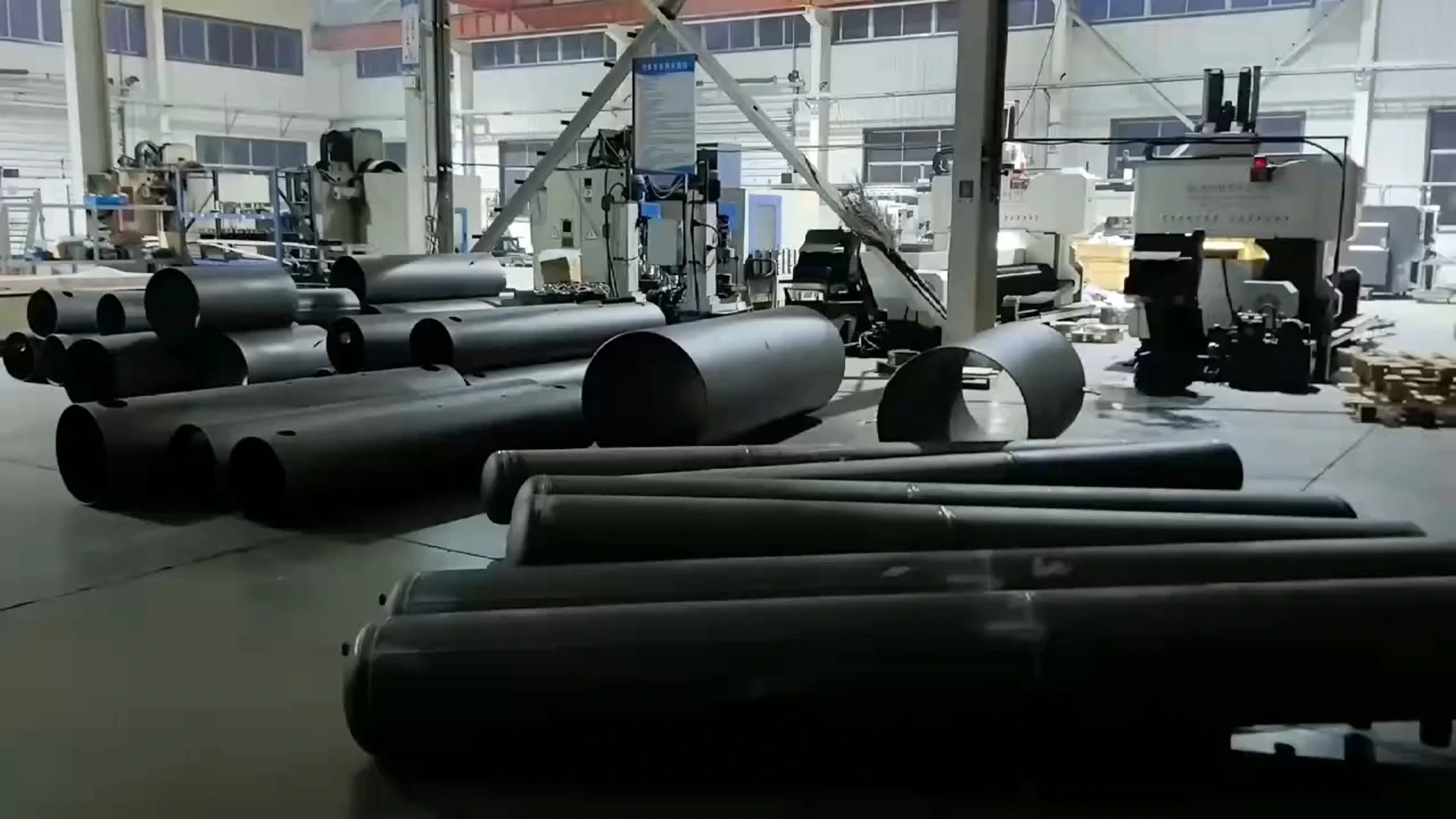
Water-Cooled Condenser
The condenser is a core heat exchange device in the refrigeration system. Its function is to cool the high-temperature and high-pressure gaseous refrigerant discharged from the compressor into high-pressure liquid refrigerant through heat exchange, providing conditions for subsequent throttling and evaporative refrigeration. Different types of condensers have significant differences in working principles, performance and application scenarios based on the differences in cooling media and heat exchange methods.
Working Principle
The core of a water-cooled condenser is the indirect heat exchange between water and refrigerant. It uses clean cooling water as the cooling medium and relies on the high thermal conductivity and large specific heat capacity of water to efficiently remove the latent heat released by refrigerant condensation (the heat released when gaseous refrigerant turns into liquid). Its specific working process is divided into three stages, and the working details of different structural types are slightly different:
• Refrigerant side circulation
The high-temperature and high-pressure gaseous refrigerant discharged from the compressor (usually at a temperature of 80-120℃ and a pressure of 1.5-5MPa depending on the type of refrigerant) enters the tube side (shell-and-tube type) or shell side (plate type, double-pipe type) of the condenser through the inlet pipeline. During the flow, the refrigerant contacts the tube wall, gradually releases heat, its temperature drops, and its state condenses from gaseous to high-pressure liquid. Finally, it flows to the throttling device (capillary tube, expansion valve) through the outlet pipeline.
• Cooling water side circulation
Driven by a water pump, cooling water (usually tap water, softened water or circulating water) enters through the cooling water inlet of the condenser and flows between the tubes (shell-and-tube type) or plates (plate type). It conducts indirect heat exchange with the refrigerant inside the tubes/plates through metal tube walls (commonly copper or stainless steel with high thermal conductivity). After absorbing the heat released by the refrigerant, the temperature of the cooling water rises (usually by 5-10℃), and then it flows to the cooling tower through the outlet pipeline. After being cooled in the cooling tower (cooled to a temperature close to the ambient wet-bulb temperature), it re-enters the condenser for cyclic operation, forming a closed-loop circulation.
• Core of heat exchange
The metal tube wall serves as the heat exchange medium. The latent heat of the refrigerant is transferred to the cooling water through the tube wall, and the cooling water takes away the heat by convection and heat conduction. Its heat exchange efficiency depends on the tube wall thickness, heat exchange area, cooling water flow rate, refrigerant flow rate and water quality cleanliness.
Product Advantages
Core Parameters
| Parameter Items | Horizontal Shell-and-Tube (Most Commonly Used) | Vertical Shell-and-Tube (for Ammonia Systems) | Plate Type Water-Cooled | Double-Pipe Type (for Small-Scale Special Use) |
| Core Structure | Horizontal cylinder + heat exchange tubes | Vertical shell + vertical tube bank | Stacked corrugated metal plates | Inner + outer coaxial coil |
| Medium Flow Direction | Refrigerant in tubes, cooling water between tubes | Refrigerant outside tubes, cooling water in tubes | Refrigerant/cooling water in separated flow channels | Refrigerant in inner tube, cooling water between tubes |
| Design Pressure | 2.5~4.0MPa (high pressure) | 1.6~3.0MPa (medium-high pressure) | 1.0~2.5MPa (medium-low pressure) | 1.0~2.0MPa (low pressure) |
| Condensing Temperature | 35~40℃ (stable) | 38~45℃ | 32~38℃ | 40~48℃ |
| Cooling Water Temperature Difference | 5~8℃ | 5~10℃ | 5~8℃ | 5~10℃ |
| Single Unit Refrigerating Capacity | 50~2000kW | 30~1000kW | 10~500kW | 5~150kW |
| Application Scenarios | Large cold storage, central air conditioning | Large ammonia refrigeration cold storage | Small water chillers, cold storage | Household/small water chiller units |
Technical Support and Services
• Customized design
Provide personalized product design and selection schemes according to customers' specific working conditions and requirements.
• Professional installation guidance
Provide detailed installation manuals and on-site technical support to ensure the correct installation of equipment.
• Full life cycle service
Provide regular maintenance, fault diagnosis and spare parts supply to ensure the long-term and efficient operation of equipment.
Frequently Asked Questions
• Thousands of cold storage cases, strength builds trust
• Supported by a professional team with a sound qualification system
• One-stop full-chain service for worry-free experience
• Customized design for precise matching of requirements
• Supply of core equipment for stable, energy-saving and high-efficiency operation
• Empowered by AI intelligence, leading the new trend of energy conservation
• Full-cycle after-sales guarantee for long-term stable operation
Related Products
• High-efficiency and energy-saving refrigeration units
• Air coolers
• Cold storage panels and cold storage doors
• Quick freezers