


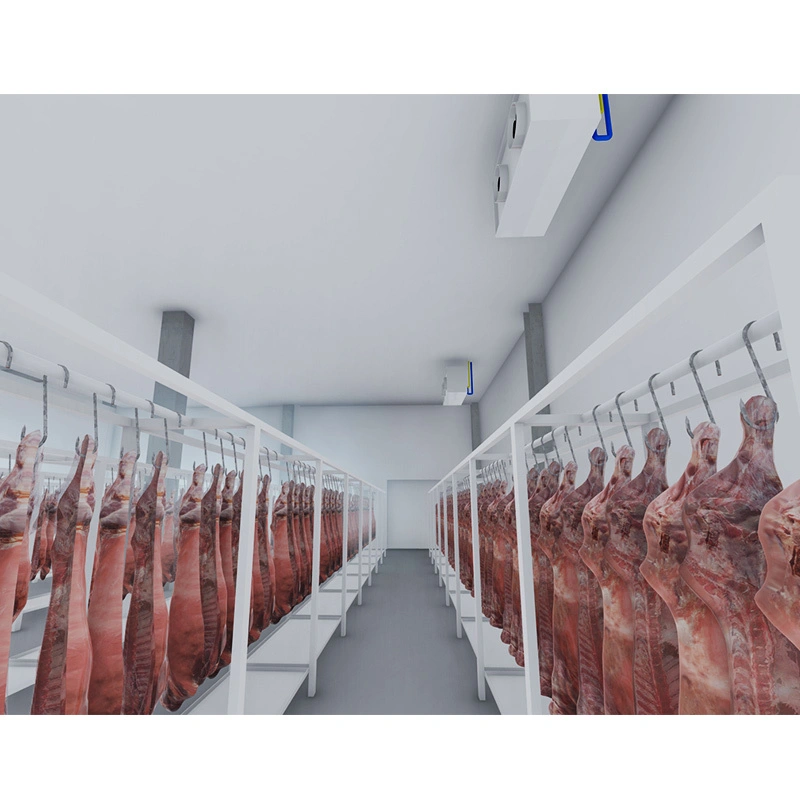
Introduction to Multi-Category Meat Storage Cold Storage
Meat storage cold storage is a core facility for ensuring meat quality and extending the preservation period. Its design focuses on two key aspects: "precision temperature control" and "high-efficiency thermal insulation". Combined with the physiological characteristics and storage cycle requirements of different meats, it scientifically sets temperature ranges and matches appropriately thick thermal insulation panels. At the same time, it integrates intelligent monitoring and AI defrosting technology, complying with refrigeration industry standards and actual operation needs. It is widely used in the entire industrial chain of meat processing, wholesale, retail, cold chain logistics, etc., and can realize partitioned and standardized storage of various meats such as pork, beef, mutton, poultry meat, and specially processed meat.
Core Design Logic
Precise Matching of Temperature and Thermal Insulation
The storage quality of meat directly depends on temperature stability and thermal insulation tightness — excessive temperature will lead to rapid microbial reproduction and meat spoilage, while excessively low temperature will increase energy consumption and damage meat fibers. The selection of thermal insulation panel thickness must strictly match the set temperature, not only to block the penetration of external heat and maintain a constant temperature in the warehouse, but also to balance operational energy efficiency and construction economy, avoiding energy waste caused by insufficient insulation or increased construction costs due to excessive insulation. Combining refrigeration industry standards and actual operation experience, this article details the suitable temperatures for different meats, the thickness of thermal insulation panels and supporting intelligent systems, ensuring that the content is in line with industry practices and usage needs.
key feature
Suitable Storage Temperatures and Core Requirements for Different Meats
Different meats vary in fat content, moisture content and fiber structure, so their requirements for storage temperature are also different. Combined with GB 12694 "National Food Safety Standard for Cold Storage Design" and industry practices, the precise storage temperatures and precautions for various meats are as follows, taking into account both short-term turnover and long-term storage needs to maximize the preservation of meat freshness and nutrition.
Livestock meat has moderate fat content and thick fibers. Temperature control needs to balance preservation and prevention of fat oxidation to avoid rancidity, while inhibiting microbial reproduction. During storage, the humidity in the warehouse needs to be controlled to prevent meat from losing water and becoming dry and tough.
• Pork
The optimal storage temperature for ordinary parts (streaky pork, hind leg meat, front leg meat) is -18℃. At this temperature, microbial reproduction basically stops, enzyme activity is greatly reduced, and safe storage can be achieved for 8-12 months. The storage period of lean meat parts can be extended to 12-15 months; for short-term turnover (1-3 months), a constant temperature of -18℃ can be maintained without adjustment. For high-quality varieties such as high-end black pork, cold storage at 0℃ to 4℃ can be adopted for 3-7 days to better maintain meat tenderness. Note: The temperature fluctuation in the warehouse must be controlled within ±0.5℃ to avoid repeated frosting and thawing, which will cause cell wall rupture, bleeding after thawing, poor taste and shortened shelf life.
• Beef
Ordinary parts (beef brisket, beef shank) are suitable for storage at -18℃, with a storage period of 6-12 months; for high-end parts (filet mignon, ribeye, snowflake wagyu) or beef planned to be stored for more than 1 year, the temperature needs to be adjusted to -20℃ to -23℃ to better lock in meat moisture and avoid meat becoming dry and tough. It is recommended to store imported high-end beef in an independent cold storage with a stable temperature of -22℃ ±0.5℃ to prevent odor contamination and quality loss. During storage, the air flow rate should be controlled at 0.3-0.5m/s to avoid direct cold air blowing forming "freezing damage spots" which affect the appearance.
• Mutton
The suitable temperature is -18℃ to -20℃, with a storage period of 8-10 months. Mutton has a relatively high fat content; excessively high temperature will easily lead to fat oxidation and odor, while excessively low temperature will increase energy consumption. The humidity in the warehouse needs to be controlled at 90%-95% (without frosting) to prevent the surface of the meat from losing water and becoming dry and tough.
Poultry meat has high moisture content, low fat content and tender meat, which is more sensitive to temperature fluctuations. The storage temperature needs to be slightly lower than that of ordinary livestock meat to avoid ice crystals piercing the meat cell walls and causing juice loss after thawing.
• Chicken
The optimal storage temperature is -18℃, with a storage period of about 10 months. Segmented parts such as chicken breast and chicken legs need to be stored in sealed packaging to reduce moisture loss; for short-term pre-cooling or to-be-delivered chicken, it can be placed in a cold storage at 0℃ to 4℃ for 3-10 days. After pre-cooling, the core temperature of the poultry meat must be ≤4℃ before being transferred to the freezer for long-term storage to avoid microbial growth.
• Duck and Goose Meat
Due to the higher fat content than chicken, the temperature needs to be controlled at -20℃ to -22℃, with a storage period of 8-10 months to avoid fat oxidation and rancidity. Before entering the warehouse, it needs to be quickly cooled to a core temperature of ≤-18℃ to reduce temperature fluctuations in the warehouse after entering and reduce the load of refrigeration equipment.
After undergoing processes such as pickling, smoking and fermentation, specially processed meat has low moisture content and relatively loose temperature requirements, but humidity needs to be controlled to avoid mold growth. The suitable temperatures vary significantly for different processing types.
• Bacon and Sausage
The suitable temperature is -10℃ to -15℃, with a storage period of more than 12 months, which not only avoids meat spoilage, but also retains its pickled flavor. For short-term turnover, it can be placed in a cold storage at 0℃ to 4℃ for 1-2 months, and the humidity needs to be controlled at 75%-80% to prevent mold.
• Fermented Meat Products (Ham, Sausage, etc.)
A constant temperature environment of 15℃ to 20℃ and a humidity of 75%-80% are required during the aging stage; during cold storage, it is suitable for storage at 0℃ to 4℃, which can extend the storage period and avoid flavor loss, complying with the requirements of "National Food Safety Standard for Hygienic Specifications for the Operation of Meat and Meat Products".
Summary
The core of multi-category meat storage cold storage lies in "temperature adaptation" and "insulation compliance". Combined with refrigeration industry standards and actual operation needs, differences in fat and moisture content of different meats determine their exclusive storage temperature ranges, and the thickness of thermal insulation panels is the key to maintaining temperature stability and reducing energy consumption. The precise matching of these two factors enables long-term safe storage of meat and minimizes quality loss and nutritional loss. This cold storage integrates an intelligent monitoring platform and an AI intelligent defrosting system, balancing practicality, energy saving and compliance, and is suitable for various scenarios such as meat processing, wholesale and cold chain logistics. It can meet the storage needs of various meats including livestock meat, poultry meat and specially processed meat, protect meat quality, assist in the efficient operation of the industrial chain, and conform to the intelligent and energy-saving development trend of the refrigeration industry.